
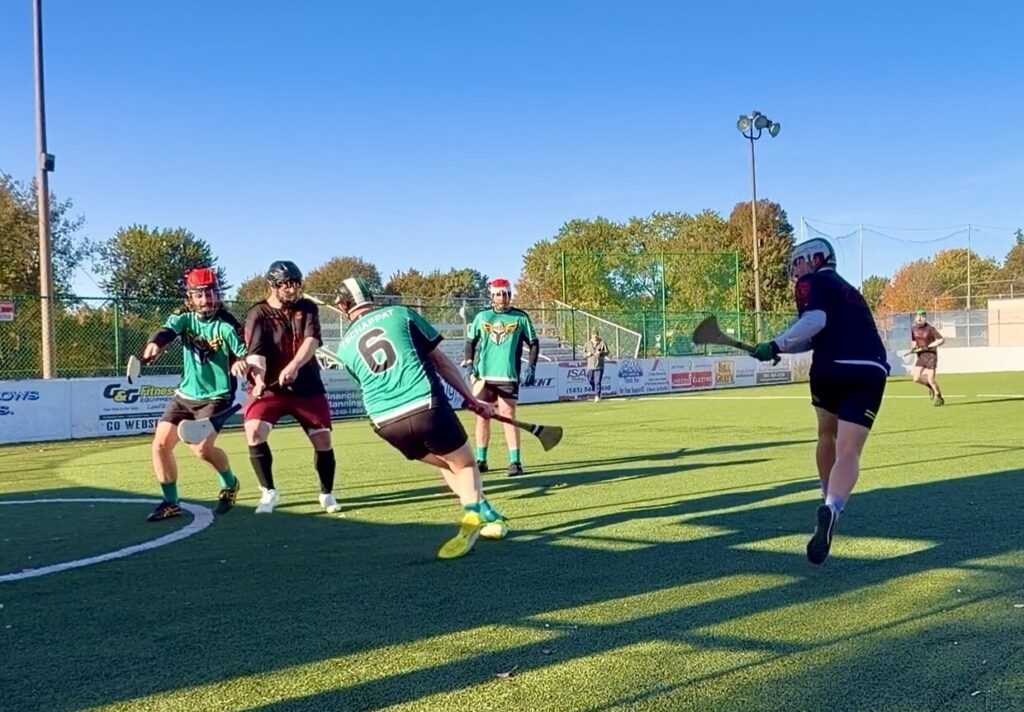
GAULS ERASE AN ELEVEN-POINT DEFICIT TO CLAIM THE CARNEY CUP IN A FINAL FOR THE AGES
By Cormac Sheehan | NBHL Reporter on Assignment
RIDGECREST PARK — October 18, 2026
There was frost in the air and a championship on the line.
At 9:30 on a Sunday morning, with the temperature barely touching 38 degrees, six men took the field at Ridgecrest Park beneath a brilliant autumn sun. There were no grandstands, no roaring crowds, no warmth to be found in the October air. Just two teams, a year’s worth of unfinished business, and one final game to settle it.
By the time it was over, the Gauls had pulled off one of the great comebacks in Carney Cup history, turning an eleven-point second-half deficit into a 32–27 victory over the Wickies.
But for much of the morning, the story appeared destined to belong to the men in black.
The Wickies Come to Fight
The Wickies had spent much of the O’Rourke Challenge Series searching for a complete team performance. There had been flashes of brilliance, individual heroics, and stretches of genuinely outstanding hurling. Too often, however, those moments had come in isolation.
On Sunday morning, with the championship at stake, they found something more.
Phill Bowen brought his customary physicality, making every contested ball an unpleasant proposition. Lucas Smith was everywhere, throwing himself into challenges and frustrating the Gauls with a remarkable 14 blocks and nine hits. And Joe Thompson, the Wickies’ relentless engine, seemed determined to drag his side toward the cup by sheer force of will.
The Gauls, meanwhile, struggled to establish the rhythm that had carried them through the series. Sean Conway, so often the architect of their attacking play, found himself working against a Wickies defense that refused to give an inch. Drew Tschappat battled for opportunities, while captain Brock Kinney worked to keep his side organized under mounting pressure.
The Wickies weren’t simply holding their own. They were taking the game away.
Deep into the second half, the scoreboard read 24–13.
An eleven-point lead. The Carney Cup within reach. The Gauls staring at the very real prospect of watching their rivals celebrate.
And then everything changed.
Nineteen to Three
The Wickies had just scored their third goal of the second half, stretching their advantage to eleven. At 24–13, the final seemed to be slipping beyond the Gauls’ reach.
What happened next would determine whether there was still a championship to fight for.
Almost immediately after the Wickies’ goal, Tschappat forced his way into a dangerous position and drew a penalty.
It was a lifeline, but hardly a guarantee.
Ridgecrest Park presented a different challenge from Rothfuss, where the previous games in the series had been contested. The penalty spot sat farther from goal, turning an already tense proposition into a considerably more difficult one.
With the Gauls trailing by eleven, the weight of the moment was unmistakable. A miss would have handed the Wickies another defensive victory and perhaps extinguished whatever belief remained on the Gauls’ side.
There was no room for hesitation.
Tschappat converted.
24–16.
Still eight points down. Still a mountain to climb. But suddenly the Gauls had something they had been missing for much of the morning.
A foothold.
A few minutes later, Tschappat worked the ball to Conway, setting him up for a one-timer. Conway struck, but the effort failed to find the net. The chance appeared to have gone begging.
Except Tschappat had followed the play.
He was there to collect the rebound and drive it home.
24–19.
Two goals. Eleven points reduced to five. The Gauls were alive.
Conway added a point to narrow the gap further, but the Wickies were not about to surrender a championship without a fight.
And Lucas Smith made certain of it.
Not Without a Fight
With the Gauls surging and the Wickies desperately needing an answer, Smith produced a moment of extraordinary determination.
A ball that might have been lost became a battle of wills. Smith refused to abandon it, fighting through the challenge of Kinney and somehow forcing it over the line.
It was not a goal born of elegance. It was a goal born of refusal.
The Wickies had been rocked by the Gauls’ sudden resurgence, but Smith had dragged them back onto their feet.
27–20.
Seven points clear again.
For a moment, the comeback had been checked. The Wickies had weathered the storm and found the response that champions are supposed to find.
But the storm was not finished.
A Game of Inches
They say sport is a game of inches.
Sometimes, it is a game of considerably less.
Conway worked himself free for a shot, creating just enough separation to send the ball toward goal. The effort took a deflection on its way through, changing its course and leaving the Wickies scrambling.
Smith, already responsible for one of the game’s great acts of defiance, raced to the goal line.
He was almost there.
Almost.
The ball crossed the line by the narrowest imaginable margin before Smith could claw it away.
A millimeter, perhaps. A fraction of a second. The difference between a heroic defensive stop and another Gauls goal.
27–23.
The Wickies had been seven points clear only moments earlier. Now the margin was four, and the Gauls could sense something extraordinary.
Still, the Wickies refused to retreat.
Rather than surrender territory and protect their advantage, they pressed high, hunting the decisive score that might finally put the game beyond reach.
They wanted the coup de grâce.
Instead, they left the door open for one of the most audacious moments of the morning.
The Hail Mary
The ball came loose.
Conway found it.
And from deep in his own end of the field, with the Wickies committed forward and the championship hanging in the balance, he launched an extraordinary effort the entire length of the pitch.
A Hail Mary.
The kind of shot that looks hopeless until, suddenly, it doesn’t.
The ball traveled the length of Ridgecrest Park and found the goal.
27–26.
One point.
An eleven-point deficit had become a single point.
The Wickies had been on the verge of lifting the Carney Cup. Now they were fighting to preserve the thinnest of leads against a Gauls side that seemed incapable of missing its moment.
The game had become almost unbearably tense.
And then came the mistake.
The Moment That Decided It
A loose Wickies pass.
Tschappat saw it.
He intercepted, took his opportunity, and finished.
Gauls 29. Wickies 27.
For the first time since the early stages of the contest, the Gauls were in front.
There would be no way back.
After spending much of the morning chasing the Wickies, the Gauls had finally caught them, passed them, and seized the championship.
But there was still one final flourish.
Tschappat sent a full-field pass toward Conway, who received it and produced a nifty move to cut inside his defender. With the Wickies’ defense beaten, Conway finished to put the result beyond doubt.
32–27.
The final whistle confirmed what had seemed unthinkable only minutes earlier.
The Gauls had scored nineteen of the game’s final twenty-two points.
They had erased an eleven-point deficit, survived a desperate Wickies response, and turned a seemingly lost championship into a victory for the ages.
Tschappat finished with five goals and two assists, adding eight hits, ten blocks, and eight takeaways in a performance that combined attacking opportunism with savvy defensive work. Conway matched him with five goals and two assists, once again demonstrating his ability to influence a contest well beyond the scoresheet.
Kinney, despite failing to find the net himself, contributed three assists and remained an important part of the Gauls’ effort.
The Carney Cup belonged to the Gauls.
A Champion Without the Cup
Yet perhaps the most remarkable individual story of the morning belonged to a player on the losing side.
Joe Thompson scored five goals, recorded ten takeaways, and blocked an astonishing 14 shots. He carried the ball through pressure, fought for possession, and repeatedly stood between the Gauls and the goal.
In a match that demanded everything of its participants, Thompson seemed determined to give more.
His performance earned him the Balty Alhern Award as Carney Cup Final MVP, decided by a vote of his fellow players.
It marked the first time in the award’s history that the honor had gone to a member of the losing team.
There is something fitting about that. Championships are decided by scores, but individual greatness is not always so easily measured. Thompson’s name will not appear on the cup this year, but his performance will remain one of the defining stories of the final.
He was magnificent in defeat.
The Difference Between Winning and Losing
For the Wickies, this will be a difficult morning to forget.
They had the lead. They had the momentum. For long stretches, they had the better of a Gauls side that had seemed nearly untouchable throughout the series.
And they had an eleven-point cushion in the second half.
But this was not simply a story of a team surrendering a lead.
Smith’s desperate goal had pushed the advantage back to seven. His attempted goal-line clearance had come within a heartbeat of denying Conway. And the Wickies’ late attacking press, an attempt to finish the contest on their own terms, had instead opened the door to a goal from the opposite end of the field.
A penalty missed. A rebound cleared. A ball stopped one millimeter sooner. A loose pass finding its intended target.
Change any one of those moments and the Carney Cup has a different home.
That is the cruelty of championship sport. The difference between glory and heartbreak is sometimes so small that it can scarcely be measured.
The Wickies deserve enormous credit for the way they approached the final. Their physicality, defensive commitment, and willingness to contest every inch of the field brought them closer to the Carney Cup than they had been all season.
The cruelest part is that so much of what they did was good enough to win.
Just not quite enough.
For the Gauls, the victory was a testament to resilience. Their most important performance of the year was not their cleanest, nor their most dominant. It was the one in which they found themselves eleven points behind, with the season nearly gone, and somehow discovered another gear.
There is a particular kind of satisfaction in winning a championship when the game has given you every reason to believe you won’t.
The Gauls earned that satisfaction on Sunday.
When the Cold Was Forgotten
By the end, the autumn sunshine still hung over Ridgecrest Park. The temperature had scarcely improved, but nobody on the winning side seemed particularly concerned about the cold.
The Gauls had their cup. The Wickies had the bitter knowledge of how close they had come. And Joe Thompson had an individual honor that acknowledged a performance worthy of a champion.
Six men had arrived on a freezing October morning to settle a season’s worth of competition.
They left behind a game that will be talked about long after the bruises fade.
The Wickies had the cup in their grasp. The Gauls had one last run in them.
And on a cold Sunday morning at Ridgecrest Park, that was the difference between heartbreak and history.