
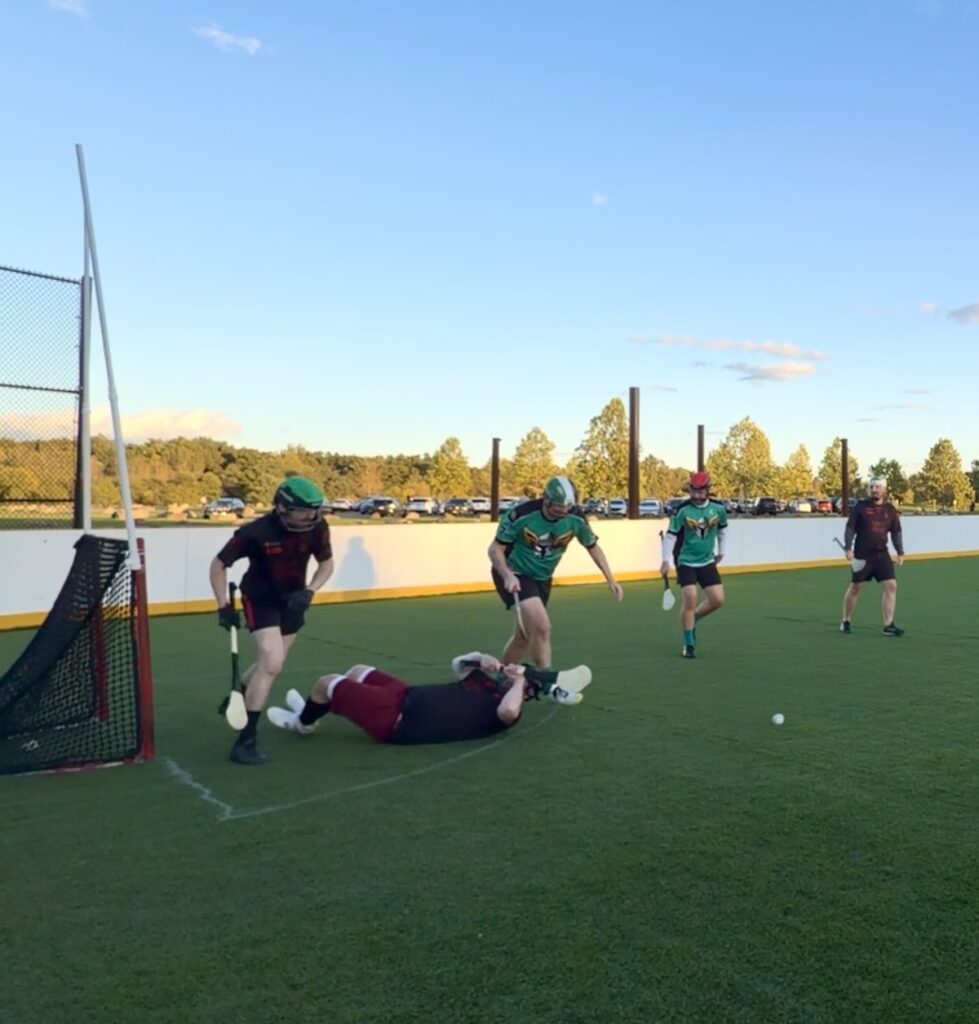
Gauls 54, Wickies 29 — O’Rourke Challenge Series, Game Two
By Cormac Sheehan
There are men who spend a game chasing it and men who wait for the game to come to them. Men who search and men who destroy.
On this night the Gauls had one of each.
But for a while it was the Wickies who had the game.
They took the early lead and held it. Phill Bowen played the old hard game, fighting for ground and making anyone entering it pay admission. Joe Thompson carried the ball out of places where there did not appear to be an escape and sent the Wickies forward again. Lucas Smith joined the work and the Gauls spent the opening part of the night looking up at them.
There was nothing accidental about it. The Wickies were quicker to the game and for a time they were better at it.
Sean Conway went looking for a way back.
He went into the corners and across the open ground and wherever the ball had gone or seemed likely to go next. He was forever available. When a teammate looked up there was Conway. When a loose ball wandered free there was Conway again. He played as though somewhere on the field there was always one more useful thing to be done and it was probably his responsibility to do it.
Drew Tschappat played by a different rhythm.
He has never needed to be everywhere. He watched the game develop and chose his moments, stepping into passing lanes, getting himself in front of shots and joining the attack when there was something there to be taken.
And when he went, he went.
Twice in the second half he took the ball himself and carried it the long way through the Wickies, turning possession into goals at the other end. They were not the plays of a man waiting around for something to happen. They were the plays of a man who had seen something and decided the time had come to make it happen.
Brock Kinney worked between them. Conway kept the Gauls connected. Tschappat kept making plays at either end. Kinney found the spaces that remained.
And little by little the early Wickies lead disappeared.
There was no great turning point. No thunderclap. No single goal after which the game became something different. The Gauls took it back a piece at a time.
A ball won. A pass completed. A shot turned aside. A run through open ground.
Then another.
At some point the Gauls drew level. Then they went ahead. And once they did, the game that had belonged to the Wickies began getting away from them in a hurry.
Then came the goals.
And then came more of them.
Bowen never stopped fighting. Thompson never stopped carrying the ball into dangerous country. The Wickies kept coming because there was nothing else worth doing. But the spaces grew larger and the Gauls grew surer of themselves, and what had begun as a Wickies game became unmistakably something else.
By then the field belonged to the Gauls.
When it was over the board read 54–29.
It was a score that gave no hint that the losing side had once been in front.
Conway had spent the game making himself part of everything.
Tschappat had spent it choosing his moments and making them count.
The Gauls needed both.