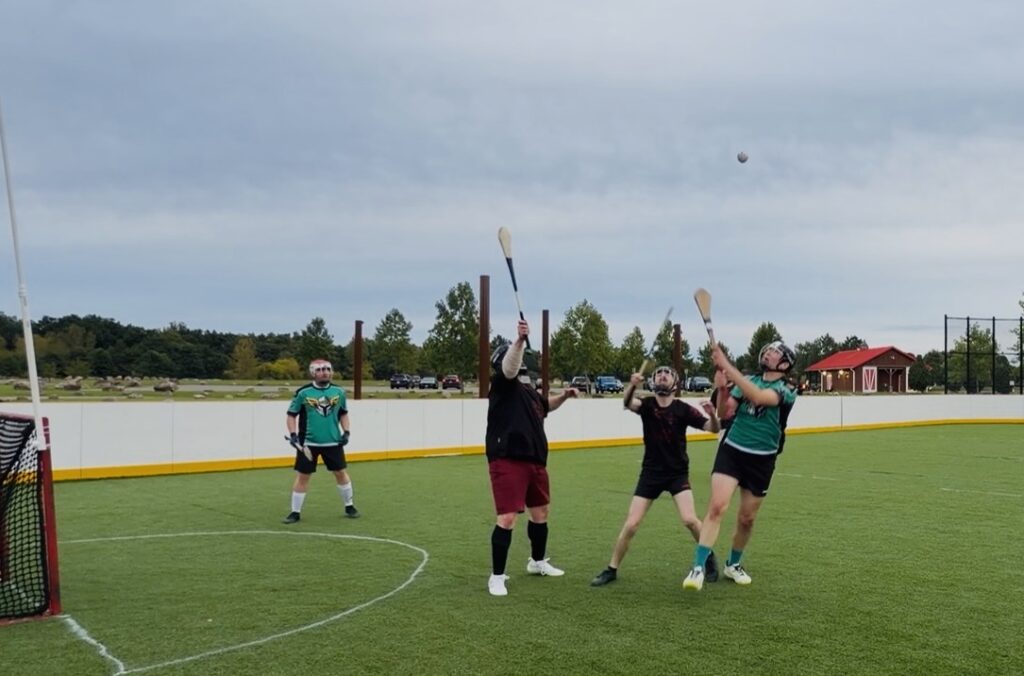
Gauls 76, Wickies 45 — O’Rourke Challenge Series, Game One
By Cormac Sheehan
It was cool and gray over Rochester when the old league came back wearing new names.
Athmor are the Gauls now. Ba Fearnog have become the Wickies. Nua Cliath are gone altogether, their folding leaving the survivors to contest three games for the newly fashioned O’Rourke Challenge Series before meeting once more for the Carney Cup.
Such are the indignities of getting old. Eventually even the things you remember start changing their names.
But there were six men on the floor, two goals at either end, and a sliotar traveling at speeds incompatible with good sense.
That part, at least, remained familiar.
What followed was less so.
The Gauls defeated the Wickies 76–45 in one of the finest displays of skill this league has produced. It was fast, open, inventive and occasionally ridiculous—a basketball game conducted with ash sticks and considerably less concern for one’s dental work.
There are men who will tell you this is what the National Box Hurling League was always supposed to look like.
Your correspondent is willing to concede the first three points.
I would still like someone to play defense.
The trouble for an old man trying to complain about the modern game, however, is that every so often the modern game becomes too damn good to complain about.
This was one of those nights.
The arrival of Sean Conway and Joe Thompson from Roc City Gaelic immediately raised the standard. They may be newcomers to this peculiar little league, but neither looked remotely like one.
Thompson spent much of the evening performing small acts of escape.
Put him against the boards and he came away with the ball. Close a lane and he found another. Get square in front of him and, rather inconveniently, discover that he was no longer there.
He recorded a game-high 12 successful carries, repeatedly turning pressure into open floor through speed, balance and the occasional juke that left a defender reconsidering his evening.
Conway was harder to explain.
He simply kept appearing in places where Wickies defenders had neglected to put a Wickies defender.
Some players create space with speed. Others create it with strength. Conway seemed to create it by possessing a private understanding with space itself.
The Gauls would move the ball, a head would turn, and there he was.
Open.
Again.
He scored 10 goals and three points, added three assists, completed 93 percent of his 43 passes, and was rightly named Man of the Match.
It was an extraordinary NBHL debut.
Across from all this youth and novelty was Drew Tschappat, who has apparently decided that 42 is an appropriate age to come back for one more season of box hurling.
He returned 35 pounds lighter and noticeably fitter, although age has a way of changing the terms under which a man plays.
Tschappat does not defend especially well one-on-one anymore. He isn’t going to chase Thompson around the floor and suddenly become 27 again.
So he doesn’t try.
His game now is angles and anticipation. He picks his moments. He finds gaps. He goes where the ball is going rather than where it has been. There are quicker men in the league now.
There may not be many who have spent more time learning where trouble will appear.
And when trouble does appear, he remains perfectly willing to put his body in front of it.
This was demonstrated midway through the first half when Phill Bowen absolutely flattened him.
Tschappat hit the floor.
Bowen remained upright.
Somewhere, the 2026 NBHL season officially began.
Welcome back.
Tschappat got up and continued doing what he had been doing, which was finding holes in a Wickies defense still becoming acquainted with itself.
He scored seven goals in the first half and assisted four more.
Conway kept finding space. Brock Kinney kept finding Conway and Tschappat. Tschappat kept finding the net.
The Gauls moved the ball beautifully.
And this is perhaps where the influence of the Roc City men was most apparent. It wasn’t simply that Conway and Thompson were individually good. The game around them became better. Decisions had to be made faster. Passes had to be sharper. Poor touches had consequences.
The whole thing seemed to accelerate.
Sometimes alarmingly so.
Shortly before halftime, Lucas Smith drove a shot that struck Tschappat directly in the windpipe.
The game stopped being funny for a moment.
There are occasions in hurling when one remembers what the sport actually asks people to do. A small, hard ball is struck with considerable force through a crowded space while everyone involved carries a wooden stick.
Most of the time we call this beautiful.
Every so often the sliotar hits a man in the throat and reminds us that it is also completely insane.
For several uneasy moments Tschappat stayed down.
Then he got up.
At 42, wisdom apparently remains a work in progress.
By halftime, the Gauls led 43–24.
The Wickies were not playing badly. That is important.
They were simply being punished for nearly everything.
And the second half began with the punishment becoming considerably more severe.
Thirteen unanswered points.
The Gauls came out of the break and ripped off a 13–0 run, turning a game the Wickies could still reasonably imagine recovering into one they would spend the remainder of the night chasing.
That stretch was the game.
Not because the Wickies folded afterward.
Quite the opposite.
Bowen began hitting everything.
He had scored once in the first half. He scored six goals in the second.
The man who had introduced Tschappat to the floor earlier in the evening now began introducing the sliotar to the back of the Gauls’ net.
Thompson continued breaking pressure. Smith continued creating chances. The Wickies kept coming.
They just couldn’t get close enough.
Every time they threatened to make the score interesting, the Gauls found another run. Every time the Wickies left a gap, somebody in green found it.
And when they made mistakes, the mistakes tended to become goals.
The cruelest example came from a Smith puck-out.
It went directly toward Tschappat.
There was no touch to settle it. No pause. No dribble. No grand act of athleticism.
Tschappat simply met the ball on the way through and sent it straight back where it had come from.
Goal.
Against lesser sides, these things become turnovers.
Against good ones, they become goals before you’ve had sufficient time to regret them.
That may be the sentence that best explains the night.
The Gauls were ruthless.
Kinney finished with four goals and six assists, quietly holding together much of what happened around him. Tschappat finished with 10 goals and six assists, while somehow adding 13 blocks, seven takeaways and 12 key passes. Conway had his 33-point debut.
Between them, Conway and Tschappat scored 20 goals.
The Wickies scored 15 as a team.
And still, strangely, 76–45 almost undersells how good the game was.
This was not 31 points of hopelessness.
It was 31 points accumulated in bursts.
It was Thompson carrying the ball through traffic. Bowen erupting after halftime. Smith creating. Kinney distributing. Conway slipping unnoticed into space that shouldn’t have existed. Tschappat standing in the gaps and waiting for the game to come to him.
It was six men playing quickly enough that mistakes became opportunities almost instantly.
There have been closer games in this league.
There have been more dramatic games.
I am not certain there have been many better-played ones.
That matters because the beginning of this season arrived beneath a small cloud.
A club had folded.
The league had shrunk.
Old names disappeared.
It would have been reasonable to wonder whether the NBHL itself had taken a step backward.
Then six men walked onto the floor on a cold, overcast fall evening and spent the next hour suggesting precisely the opposite.
Conway and Thompson did more than strengthen their respective clubs. Their presence raised the technical standard of the game around them. The old hands had to adjust. The ball moved faster. Space disappeared quicker. Skill was punished by skill.
Perhaps this smaller league has found a way to become a better one.
Perhaps the O’Rourke Series will give us three games like this.
If so, your correspondent will happily spend the autumn watching them.
I ask only one small favor.
Now if somebody would kindly teach the six of them to defend, we may really have something.